
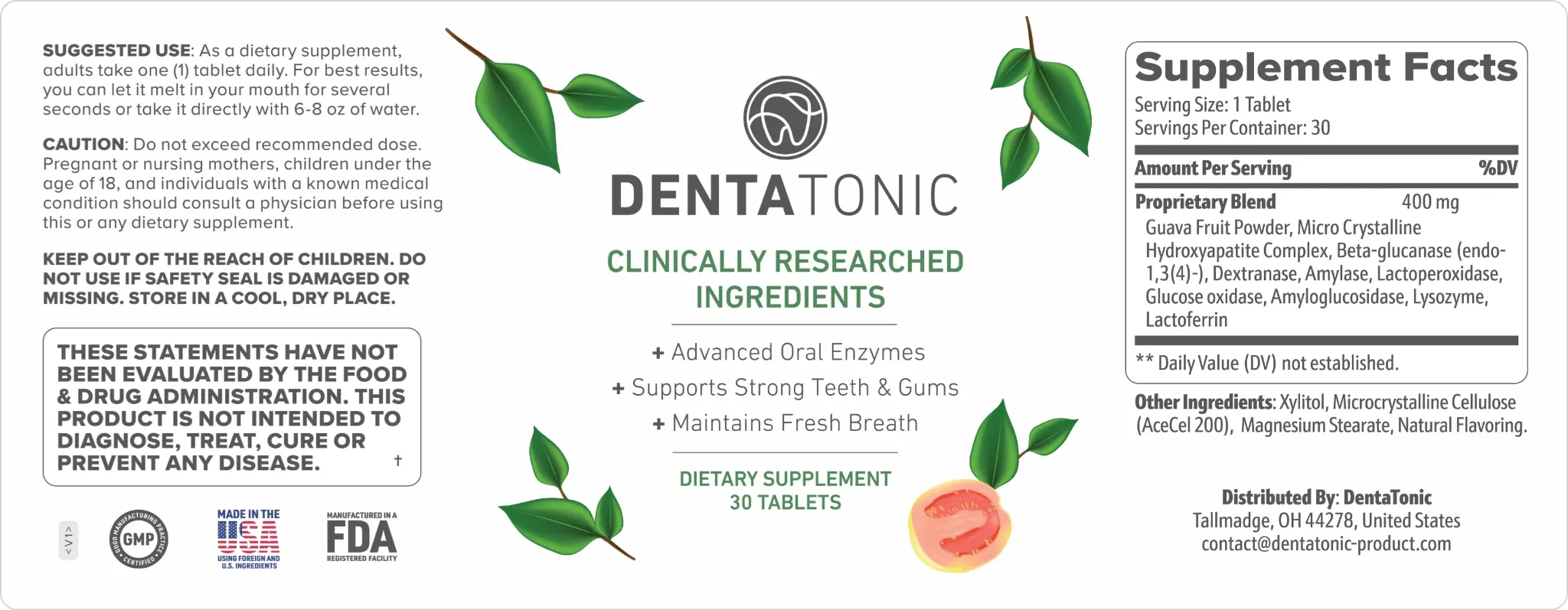
The label at a glance
That 400 mg number applies to the whole blend, not to each ingredient. The label does not tell us how much lactoperoxidase, hydroxyapatite, or guava powder is present individually. A useful question to ask the seller is whether individual amounts and allergen sourcing can be provided.
All 10 ingredients on the Supplement Facts label
Below is a plain-English reading of the supplied label. These notes describe what each substance is or where it is commonly discussed; they are not proof that this particular formula treats a dental condition.
1. Guava fruit powder
Guava is a fruit used in food and botanical preparations. Here it appears as part of the proprietary blend. The label does not disclose how much guava powder each tablet contains.
2. Microcrystalline hydroxyapatite complex
Hydroxyapatite is a calcium-phosphate mineral related to the mineral found in teeth. It has also been investigated in oral-care products, particularly toothpastes. An ingredient appearing in a swallowed or dissolved supplement is not the same as a proven enamel-repair treatment.
3. Beta-glucanase (endo-1,3(4)-)
Beta-glucanase is an enzyme that acts on certain beta-glucan carbohydrates. Its presence is consistent with DentaTonic’s enzyme-focused formulation, but the label provides no individual dose.
4. Dextranase
Dextranase breaks down dextran, a carbohydrate that can be involved in some microbial surface films. Researchers have investigated dextranase in oral biofilm contexts. That does not establish that the finished tablets prevent cavities.
5. Amylase
Amylase helps digest starches. Your own saliva normally contains amylase. The formula lists additional amylase among its ingredients.
6. Lactoperoxidase
Lactoperoxidase is naturally found in saliva and participates in antimicrobial chemistry in the mouth. It is a central ingredient in the product’s marketing story. Evidence about natural saliva function should not be confused with proof that these tablets restore an individual’s enzyme levels.
7. Glucose oxidase
Glucose oxidase is an enzyme involved in reactions with glucose and oxygen. It appears in some multi-enzyme systems discussed in oral-care research.
8. Amyloglucosidase
Amyloglucosidase is another carbohydrate-processing enzyme. It helps release glucose from starch-derived molecules in certain conditions.
9. Lysozyme
Lysozyme is a protein present in saliva and tears. It is part of the body’s normal defense against some microorganisms and has been studied for its role in oral environments.
10. Lactoferrin
Lactoferrin is an iron-binding protein present in several bodily fluids. Because ingredients and their sources can matter for allergies, ask the manufacturer to verify the source of the lactoferrin in your specific product if you have concerns.
What are the other ingredients?
The label also lists xylitol, microcrystalline cellulose (AceCel 200), magnesium stearate, and natural flavoring. These are separate from the named 400 mg proprietary blend and may serve roles in taste, texture, or tablet manufacturing. The image provided does not specify individual quantities for them either.
The label’s presence of xylitol is not a reason to leave these tablets where animals can reach them. Keep the product out of the reach of children and pets, and follow the storage and safety directions.
What the ingredient list cannot tell you
- Whether the finished DentaTonic formula has been tested in rigorous human clinical trials.
- The quantity of each ingredient inside the 400 mg blend.
- Whether the product is appropriate for an individual allergy, medication, or dental condition.
- Whether it will eliminate plaque, cure gum disease, repair a cavity, or whiten teeth.
If you have active tooth pain, swelling, bleeding gums, or a loose tooth, contact a dental professional rather than relying on a supplement.
Common questions about DentaTonic ingredients
Does 400 mg mean 400 mg of hydroxyapatite?
No. The label says the full proprietary blend totals 400 mg per tablet. It doesn’t publish a separate hydroxyapatite amount.
Does DentaTonic contain lactoperoxidase?
Yes, lactoperoxidase is explicitly included in the supplied Supplement Facts list. Its individual amount is not listed.
Is DentaTonic an FDA-approved dental treatment?
No. It is marketed as a dietary supplement. The FDA does not generally approve dietary supplements for safety and effectiveness before sale.
Sources and how to interpret this guide
We read the DentaTonic bottle label and the product’s promotional text for product-specific information. These sources tell us what is listed or claimed; they do not by themselves establish clinical effectiveness.
- DentaTonic label supplied with this guide — ingredients, dosage, caution, and servings.
- American Dental Association: Oral-health recommendations — routine preventive care.
- U.S. Food and Drug Administration: FDA 101 — Dietary Supplements — how dietary supplements are regulated.
- Our editorial policy — sourcing and corrections.
This is an independent informational website, not the DentaTonic manufacturer or a dental clinic. Product details and advertised promotions may change. Reviewed November 22, 2026.